Fort Kochi lies at the tip of a small peninsular that juts out into the Arabian Sea from the south west Indian state of Kerala. The town feels a little bit like an Indian version of St Ives. It's full of wonky old buildings, craft bazaars, antique shops and has a bit of an art and gallery scene going on. There's also loads of little tea rooms where you can get a fresh brew and a slice of cake. They've even managed to get the bad service spot on so that it's just like being back at home!
Kerala has a reputation of being the most laid back state in the whole of India, where everything slips into second gear. This easy going nature is all very well but it appears that the staff in the restaurants take it a little bit too far, getting served anywhere is nigh on impossible. On Sunday night dinner took so long at a restaurant called "Upstairs" that it may have well have been breakfast by the time they got round to serving it.
Despite the fact that you can't get anything to eat the laid back Keralan attitude does make Fort Kochi a nice place to spend a few days. The cantilevered Chinese fishing nets that line the northern tip of the Kochi peninsular are probably the most recognisable sight in Kerala.

The nets, which take at least 4 people to operate, where bought to the area in the 15th century by Chinese traders. We spent a bit of time yesterday helping out (or should that be hindering) on one of the nets. I thought I'd let Liz get on with the heavy manual labour whilst I had the much more tiring job of taking a few photos . . .


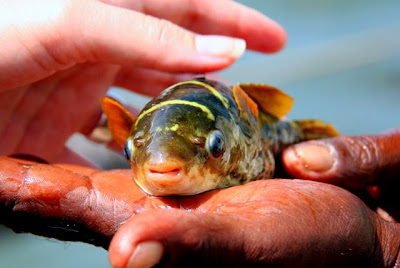
Earlier in the day the guys on the net had caught this funny little fella called a frog fish, so called as he gives a frog like croak when prodded!
Kochi is also home to St Francis Church which dates from 1503 and is thought to be the oldest European built church in India.

Vasco da Gama, the legendary Portuguese explorer, died here in 1524 and was buried in the church for 14 years before being moved back to Lisbon.
Earlier today we went over to the eastern side of the peninsular to the district of Mattancherry. Whilst there we paid a visit to Mattancherry Palace, a Portuguese built palace from 1555 which was a gift for the raja of Cochin. The palace is home to some much revered Hindu murals, one of which features, to quote our guidebook, "Krishna using his six hands and two feet to engage in foreplay with eight happy milkmaids" . . . a nice trick if you can do it! Unfortunately the part of the palace with the said mural was under renovation and out of bounds (making a complete waste of our six and a half pence entrance fee). The area around Mattancherry Palace is also known as Jew Town as it is where the Jewish traders set up their businesses in the 1500's. At the centre of Jew Town is the ornate Pardesi Synagogue.

The interior is decorated with a gold pulpit, glass chandeliers and hand-painted Chinese tiles. Unfortunately we weren't allowed to take any photos inside.
We've also bumped into Leigh and Nicola again whilst we were here and have arranged to meet them again in Varkala next week.


 Posts
Posts


